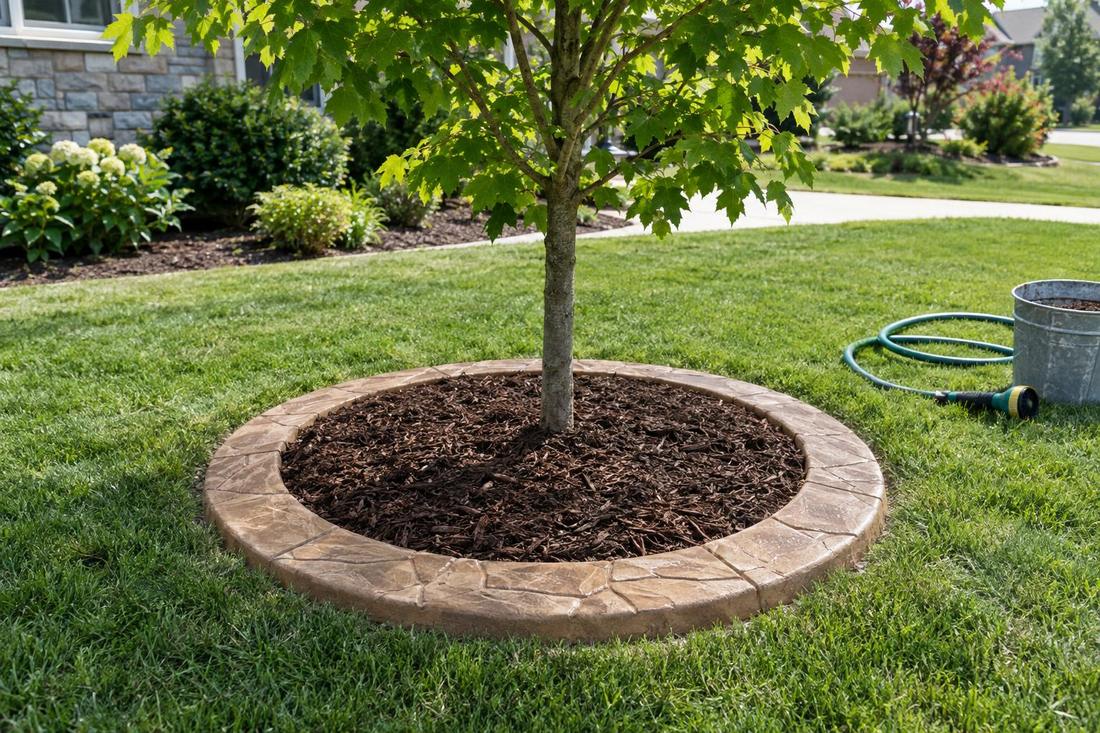
Key takeaways
- Mowers and trimmers are a leading cause of trunk damage, and a ring keeps them away.
- Bigger rings give roots more protected space, and many are three to six feet across.
- Mulch should be two to three inches deep and kept off the trunk.
- Do not pile soil or mulch against the trunk or bury the root flare.
Why a ring helps
Bark protects the tree, and damage from mowers and string trimmers opens the way for disease and insects. A ring keeps equipment away, holds mulch in place and stops grass from competing with the roots. It also makes the tree look like a feature.
Young trees benefit most because their bark is thin.
Choosing a size
The ring should leave room for the trunk to grow and for roots to spread. As a rule of thumb, bigger is better, and a ring a few feet wide is a common start. For large trees, rings can be much wider. Oval or irregular rings suit beds with several trees.
Consider where roots and utilities are before digging.
What goes inside
Mulch is the usual choice, spread two to three inches deep and pulled back from the trunk. Shade-loving groundcovers and bulbs can add color. Avoid plants that need heavy watering or digging near roots.
Never cover the root flare, the spot where the trunk widens at the base.
Common mistakes
Volcano mulching, piling mulch high against the trunk, holds moisture against the bark and invites rot. Digging deep near roots damages them. Rings that are too small squeeze root growth.
Your contractor should check root locations before pouring.
Official sources and further reading
- Arbor Day Foundation
- Trees Are Good (International Society of Arboriculture)
- University of Tennessee Extension
These are independent organizations. Links open in a new tab.
Quick answers
Will a ring hurt the roots?
A ring sits on the surface and does not squeeze roots, though we avoid deep digging.
Can I add a ring to an old tree?
Yes. We hand-dig around roots and adjust the shape.